By Jack Garrison · 15th July 2026
Bleeding, recession, sensitivity — these aren’t just “normal brushing side effects.” They’re signs your electric toothbrush might be the wrong tool for the job. Here’s what an electric toothbrush for gum care actually looks like.
You know the moment. You’re standing at the bathroom sink, finishing your two-minute routine, and when you spit, there it is — a faint pink tinge in the foam. Your gums have bled again.
You tell yourself it’s normal. Everyone’s gums bleed a little, right? You’ll just brush more gently tomorrow. Maybe angle the bristles differently. Maybe switch to the “sensitive” mode you never use. Maybe this is just what happens when you take oral care seriously.
Here’s the uncomfortable truth your dentist wishes more patients understood: bleeding gums are not normal. They are a signal. And in many cases, that signal is not about your brushing technique. It’s about the tool you’re using.
If you have been searching for an electric toothbrush for gum care that doesn’t force you to choose between a thorough clean and a comfortable one, what you’re about to read could change your morning routine — and your long-term gum health.
The Problem No One Warned You About

Most premium electric toothbrushes are engineering marvels. They pack precision motors, custom-tuned waveforms, and enough processing power to guide a small drone. They vibrate at 40,000, 50,000, even 62,000 strokes per minute. They connect to your phone and score your brushing coverage.
They were also designed around a single metric: plaque removal on flat tooth surfaces. And on that metric, they perform admirably.
The problem is what happens at the gumline — the delicate boundary where hard enamel meets soft, living tissue. When a bristle tuft vibrating at 40,000 cycles per minute sweeps across this junction, your gums don’t experience “cleaning.” They experience thousands of micro-impacts per second. Over days, weeks, and years of twice-daily sessions, this cumulative mechanical stress contributes to the very gum problems you bought an expensive toothbrush to prevent: inflammation, bleeding, and the slow, creeping retreat of gum tissue away from teeth known as recession.
The manufacturers know this. That’s why they include a “sensitive” mode that simply runs the motor at lower power. It’s the engineering equivalent of putting a bandage on a design flaw. The fundamental mechanism — high-frequency bristle contact as the sole cleaning modality — remains unchanged. Turned down, but not rethought.
RANVOO Asked a Different Question
What if the way to protect gums wasn’t to do less of the same thing, but to do something entirely different?
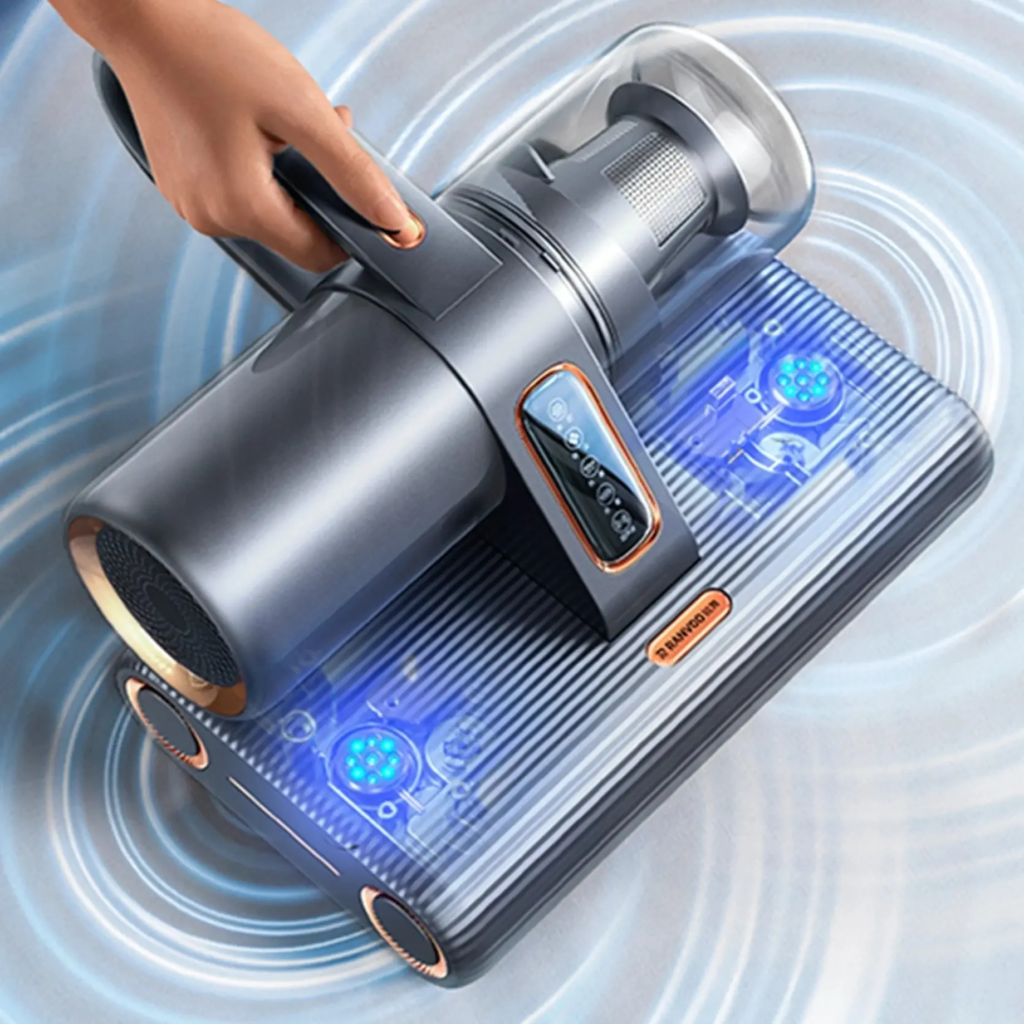
The team behind the AirJet X5 — an electric toothbrush for gum care backed by 20 granted patents — started from an observation that, once articulated, feels almost obvious: the most demanding cleaning task in your mouth is not the broad surfaces of your teeth. It’s the narrow, hidden spaces between them. Those spaces are where over 80% of cavities begin. They are also where plaque accumulates against gum tissue, triggering the inflammatory response that makes gums bleed.
In a conventional toothbrush, bristles are responsible for everything — surface polishing and interdental cleaning alike. And because bristles struggle to clean between teeth even under ideal conditions, the industry’s solution has been to keep adding speed. Faster bristles. More impacts. More mechanical energy. More stress on gums.
RANVOO‘s insight was to break the link. In the AirJet system, interdental cleaning is performed not by bristles, but by fluid dynamics — a precisely engineered stream of microbubbles that flows into the spaces bristles can’t reach and cleans through acoustic cavitation, not abrasion. With that demanding task reassigned to fluid physics, the bristles are freed to operate at a deliberately low, gum-safe frequency.
The result: 97% plaque removal, Grade 1 cleaning efficiency, and a brushing experience so gentle that users with long-standing gum sensitivity report noticing the difference within days.
Speed Isn’t the Answer. Smart Design Is.
The AirJet X5 operates at a maximum of 21,600 strokes per minute. In a market where “premium” has become synonymous with “faster,” that number might look underwhelming. It is, in fact, the single most important specification for gum safety in any electric toothbrush.
Here’s why. Healthy gum tissue has a natural viscoelastic property — it compresses under pressure and rebounds when pressure is removed. But like any living tissue, it needs time to recover between impacts. At 40,000 strokes per minute, the interval between bristle contacts is measured in microseconds. Gum tissue doesn’t have time to decompress before the next impact arrives. The result is sustained compression — the mechanical equivalent of never taking your finger off a bruise.
At 21,600 strokes per minute, paired with a narrow 12° oscillation arc, the AirJet X5 gives gum tissue roughly twice the recovery interval of a typical premium sonic brush. The difference may sound small on paper. On gums — particularly gums that are already inflamed, receding, or healing — it is transformative.
And because the interdental cleaning is handled by the microbubble cavitation system, not by bristle speed, this lower frequency does not mean a less effective clean. It means a cleaner mouth with less collateral damage to the soft tissue that holds your teeth in place.
The Bristles Your Gums Deserve
There is a detail about most toothbrush bristles that manufacturers rarely discuss: under a microscope, many of them look like tiny hypodermic needles.
The nylon extrusion process that produces bristle filaments leaves microscopic irregularities at the cut tip — jagged edges, sharp burrs, uneven fracture surfaces. When these imperfections drag across gum tissue thousands of times per minute, they create micro-abrasions. Not enough to cause immediate pain. More than enough to contribute to chronic inflammation, bleeding, and the gradual thinning of gum tissue over time.
End-rounding is the manufacturing process that polishes these tips into smooth domes. And the difference between “rounded enough to pass inspection” and “truly gum-safe” is measured in decimal points.
The AirJet X5’s bristles are polished to a 99.99% end-rounding rate. Each tip measures 0.01 millimetres across — roughly a tenth the diameter of a human hair — and presents a smooth hemispherical surface to anything it touches. These bristles don’t scratch. They glide. For gum tissue that has spent years absorbing the micro-trauma of poorly finished bristles, the difference is something you feel the first time you use the brush — a sensation less like scrubbing and more like a gentle massage.
The brush head even includes a soft thermoplastic elastomer layer on its back surface. It’s there to absorb vibration if the head accidentally taps an adjacent tooth — a small, almost invisible design choice that turns a sharp, jarring moment into something you don’t notice. It’s the kind of detail you’d only think to include if you were engineering a brush for people whose gums can’t tolerate another compromise.
Four Modes, Each One Gum-Aware
Many electric toothbrushes offer modes that sound impressive — “Gum Care,” “Sensitive,” “Massage” — but simply adjust the two-minute timer or slightly reduce motor speed. The AirJet X5 takes a different approach. Every mode is defined by four independently calibrated parameters, and every mode is designed with gum safety as a non-negotiable baseline.
Bubble Mode delivers maximum interdental cleaning at 1,000 millilitres per minute of microbubble-infused flow, with a tight oscillation arc that minimises gum contact. Sensitive Mode reduces fluid pressure to 500 millilitres per minute and widens the sweep to provide gentle stimulation — ideal for active gingivitis or post-procedure recovery. Clean Mode balances frequency and flow for daily maintenance. Whitening Mode alternates dual frequencies for stain management without the abrasive toothpaste additives that can irritate sensitive gums.
The point is not that one mode is “the gum mode.” The point is that gum safety is built into every mode, at every parameter setting, as a first principle rather than an afterthought.
The Electric Toothbrush for Gum Care That Earns the Title
There are dozens of electric toothbrushes that claim to be gentle on gums. Most of them are fast brushes with a slow setting. The AirJet X5 is something different.
It is a brush that fundamentally separates the task of interdental cleaning from the task of surface polishing. It delegates the tough, gap-cleaning work to fluid physics — microbubbles, the Coanda effect, acoustic cavitation — so the bristles never have to compromise gum safety for cleaning performance. It operates at a frequency calibrated to the biological recovery rate of gum tissue, not to the demands of a marketing specification sheet. Its bristles are polished to a standard most manufacturers don’t bother reaching because most consumers never think to ask.
If your gums bleed when you brush, if your dentist has mentioned recession or pocketing, if you have been brushing “more gently” for years while watching your gum line slowly retreat — the tool in your hand may be part of the problem. The AirJet X5 was built for exactly that realisation.
Your gums have been sending you a signal. Maybe it’s time to answer with more than a softer touch. Maybe it’s time to answer with better engineering.